
By Kasama Safety Team | Last updated 03/27/2026
Running a warehouse means managing dozens of safety variables at once — from forklift traffic and rack stability to emergency exits and chemical storage. A structured safety audit helps you catch hazards before they become injuries or OSHA citations. The challenge is knowing exactly what to inspect and how often.
This guide walks you through a practical warehouse safety audit checklist organized by the areas that matter most, so you can identify risks, stay compliant, and protect your team.
Why Warehouse Safety Audits Matter
Warehouse workers face injury rates well above the national average across all industries. OSHA reports that forklift-related incidents alone cause approximately 100 fatalities and 95,000 injuries annually in U.S. warehouses. Regular safety audits are one of the most effective tools for reducing these numbers.
Beyond protecting people, audits also protect your bottom line. A single serious OSHA violation can cost up to $16,550 per instance, while willful or repeated violations can reach $165,514. Factor in the indirect costs — higher insurance premiums, lost productivity, equipment damage, and reduced employee morale — and the case for proactive auditing becomes clear.
How Often Should You Audit?
Best practice breaks warehouse audits into a layered schedule. Daily walk-throughs should cover basic housekeeping and forklift pre-shift inspections. Weekly spot checks by supervisors should target high-risk zones like loading docks and chemical storage. Monthly or quarterly full-facility audits led by your safety team should cover everything on this checklist comprehensively.
OSHA requires employers to inspect the workplace periodically and conduct at least one full annual safety and health review. But the companies with the best safety records go well beyond the minimum.
1. Floor Marking and Pedestrian Safety
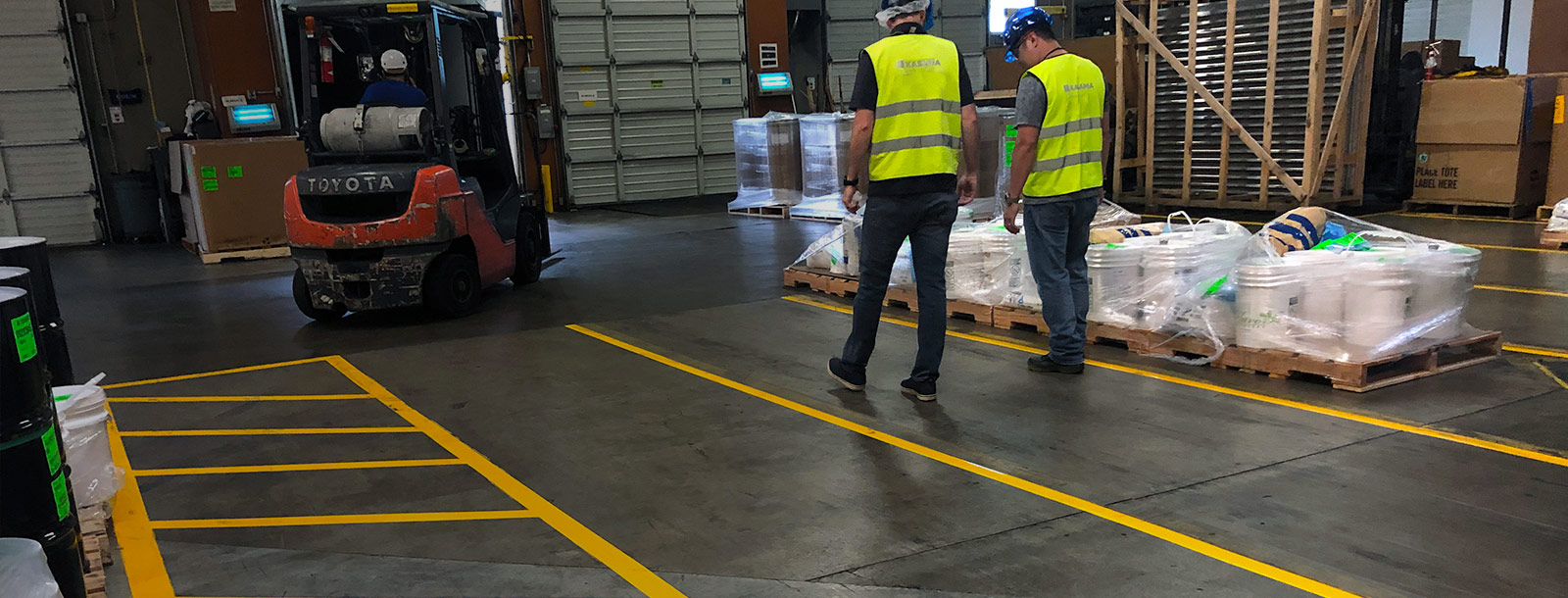
Walk your facility and check that all floor marking is intact, visible, and correctly placed. Faded, peeling, or missing lines create confusion about safe walkways, forklift lanes, and hazard zones.
Inspect for:
- Clearly marked pedestrian walkways separated from forklift traffic
- Yellow boundary lines around electrical panels (with 36-inch clearance maintained)
- Hazard zones marked with appropriate colors per OSHA and ANSI standards
- Pallet storage locations clearly outlined to prevent aisle encroachment
- Emergency exit paths marked and unobstructed
- Floor tape condition — look for peeling edges, fading, or damage from forklift traffic
- Inspect for leaks
Tip: If your floor tape is getting chewed up by forklift traffic, consider upgrading to an industrial-grade floor marking tape designed for heavy-duty environments.
2. Forklift and Powered Industrial Truck Safety
Forklifts are the number one hazard source in warehouses according to OSHA, and powered industrial trucks ranked 8th on OSHA's top 10 most cited violations in FY 2025 with 1,826 total violations.
Inspect for:
- Pre-shift inspection logs being completed daily by operators
- Valid operator certification and training records (recertification required every 3 years)
- Functional brakes, steering, lights, horn, and warning devices
- Tire condition and fork integrity — no cracks or bending
- Proper speed limits posted and enforced in all areas
- Seatbelt usage compliance
- Pedestrian awareness protocols at blind corners and intersections
- Inspect for leaks
3. Racking and Storage Systems
Damaged or overloaded racking is one of the most dangerous hazards in a warehouse. A single rack failure can cause a catastrophic domino collapse.
Inspect for:
- Bent, dented, or twisted uprights and beams
- Missing or damaged safety clips and beam connectors
- Load capacity placards posted and not exceeded
- Pallets stored evenly and not overhanging edges
- Rack anchor bolts secure and undamaged
- Rack protection guards and bollards in place at row ends and high-traffic areas
4. Hazard Communication and Chemical Storage
Hazard communication was the 2nd most cited OSHA violation in FY 2025, with 2,546 total violations. This standard requires employers to maintain a written HazCom program, properly label all chemical containers, keep Safety Data Sheets accessible, and train employees on chemical hazards.
Inspect for:
- Written hazard communication program on file and up to date
- All chemical containers properly labeled with GHS-compliant labels
- Safety Data Sheets (SDS) readily accessible to all employees
- Secondary containers labeled when chemicals are transferred
- Proper segregation of incompatible chemicals
- Spill containment and cleanup supplies available
- Emergency contacts
- Appropriate warning signs posted in chemical storage areas
5. Lockout/Tagout (LOTO) Procedures
Control of hazardous energy ranked 4th on OSHA's most cited list in FY 2025 with 2,177 violations. Failure to properly lock out equipment during servicing and maintenance puts workers at risk of serious injury or death from unexpected machine startup.
Inspect for:
- Written LOTO procedures for each piece of equipment
- Lockout/tagout devices available and in good condition
- Employee training records current and documented
- Annual LOTO procedure inspections completed
- Authorized vs. affected employee roles clearly defined
6. Fire Safety and Emergency Preparedness
A warehouse fire can escalate rapidly given the volume of stored materials. Your audit should verify that prevention systems are functional and evacuation procedures are well-practiced.
Inspect for:
- Fire extinguishers accessible, inspected monthly, and serviced annually
- Sprinkler systems unobstructed (18-inch clearance below sprinkler heads)
- Emergency exits clearly marked, illuminated, and unblocked
- Evacuation routes posted and familiar to all employees
- Emergency lighting tested and functional
- Fire alarm pull stations accessible and tested
- Ensure muster point is identified
- Hearing protection devices are checked daily
- Ensure respirators are inspected daily
7. Personal Protective Equipment (PPE)
Eye and face protection ranked 9th on OSHA's FY 2025 most cited list with 1,665 violations. But PPE compliance extends well beyond eye protection in a warehouse environment.
Inspect for:
- Hazard assessments completed to determine required PPE for each task
- High-visibility vests worn by all personnel in forklift traffic areas
- Hard hats required and worn in overhead hazard zones
- Safety glasses, gloves, and steel-toe footwear available and in good condition
- PPE training records current for all employees
8. Loading Dock Safety
Loading docks are high-activity transition zones where many warehouse injuries occur. The combination of forklifts, trucks, pedestrians, and weather exposure creates unique hazards.
Inspect for:
- Wheel chocks or vehicle restraints used to prevent trailer movement during loading
- Dock plates and levelers in good condition with anti-slip surfaces
- Adequate lighting at all dock positions
- Dock edges clearly marked with high-visibility floor marking
- Trailer inspection before entering (floor integrity, securement)
- Communication protocol between dock workers and truck drivers
9. Housekeeping and General Conditions
Poor housekeeping is a root cause of slips, trips, and falls — consistently among the top injury categories in warehouses.
Inspect for:
- Aisles clear of debris, spills, and obstructions
- Adequate lighting throughout the facility, especially in storage areas and stairwells
- Proper waste disposal and recycling procedures followed
- Damaged flooring, potholes, or uneven surfaces repaired
- Electrical cords and hoses routed to avoid tripping hazards
- Restrooms and break areas clean and sanitary
10. Training and Documentation
Even the best safety equipment and procedures are only effective if your team knows how to use them. Training gaps are one of the most common reasons OSHA issues citations.
Inspect for:
- New employee safety orientation completed and documented
- Forklift operator certifications current (every 3 years)
- Annual refresher training on hazard communication, LOTO, and emergency procedures
- Training records organized and accessible for OSHA inspection
- Safety meeting logs maintained
- Incident reports filed and corrective actions documented
After the Audit: What to Do with Your Findings
Completing the checklist is only half the job. For each hazard you identify, classify it by risk level — high, medium, or low — and assign corrective action to the supervisor closest to the issue. Set clear deadlines and schedule a follow-up inspection to verify that fixes were implemented.
Keep all audit records on file. OSHA can request documentation during an inspection, and a strong audit trail demonstrates your commitment to workplace safety. It also helps you track trends over time — if the same issues keep appearing, it may signal a need for better training, upgraded equipment, or process changes.
Need Help with Your Warehouse Safety Program?
At Kasama, we help warehouses and manufacturing facilities across the country implement effective safety marking, signage, and compliance solutions. From floor marking tape and safety barriers to custom safety signs and lockout/tagout products, we carry everything you need to address the most common audit findings.
We also offer professional installation services nationwide for floor marking and safety barriers — so you can get compliant fast without pulling your team off their regular duties.
Schedule a free safety walkthrough or call us at 1-844-4KASAMA to talk with a safety expert about your facility.