
Standardizing Pipe Marking
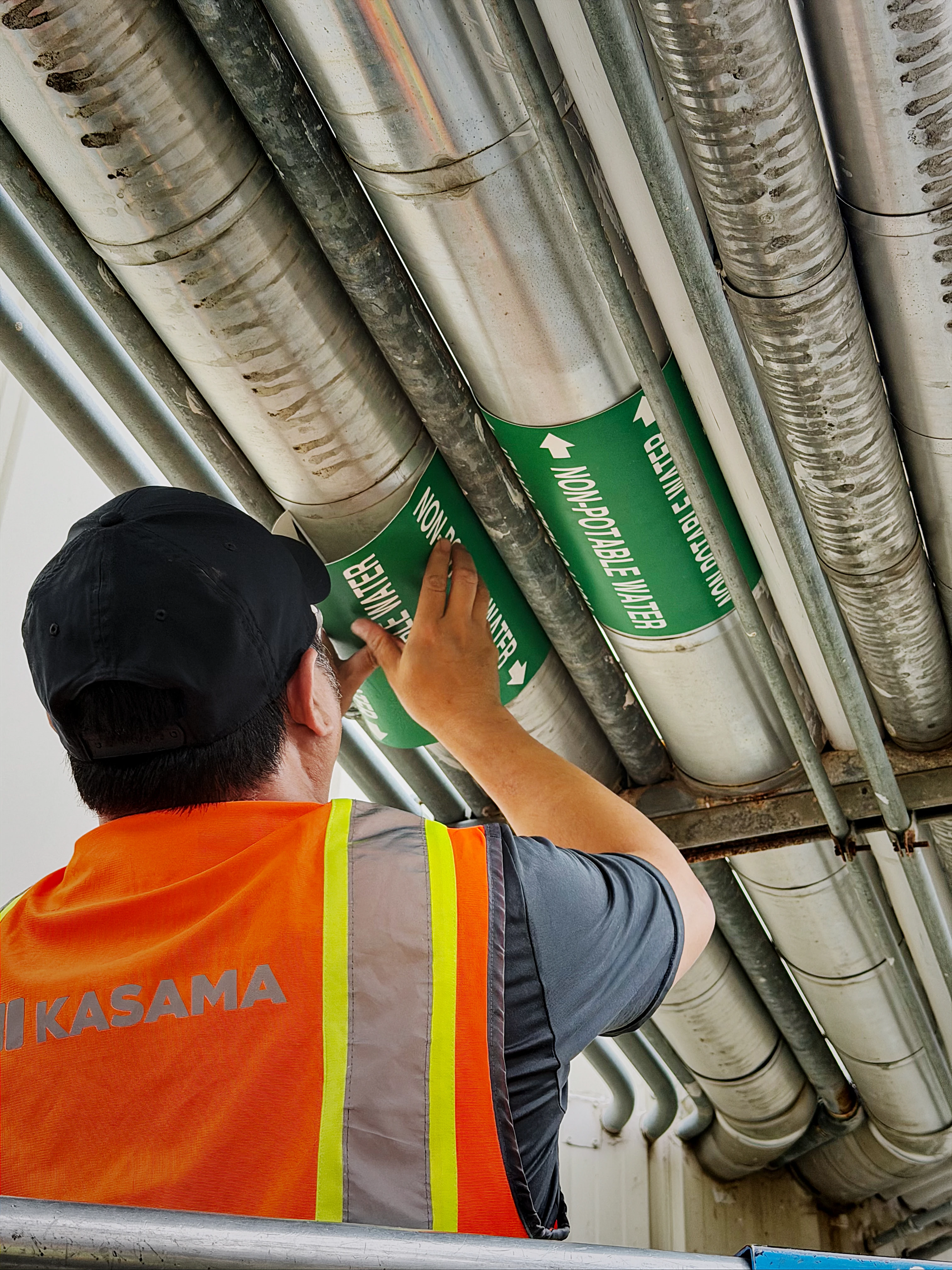
ANSI/ASME A13.1 is the most widely recognized pipe identification standard in the United States. The standard establishes a consistent method for identifying pipe contents, flow direction, and hazard classifications through the use of pipe markers, colors, legends, and directional arrows. Proper pipe marking improves workplace safety, reduces maintenance errors, and helps emergency responders quickly identify piping systems during an incident.
Whether your facility contains compressed air, potable water, natural gas, steam, chemicals, or fire protection systems, clearly identifying piping systems helps eliminate confusion and creates a safer work environment. ANSI/ASME A13.1 provides a standardized approach so employees, contractors, and visitors can immediately understand the contents and hazards associated with a pipe system.
Steam Pipe Marking: What Color Should It Be?
Steam is one of the most common and most dangerous services in a facility, and it is also one of the most often mislabeled. High-pressure steam can cause severe burns and fails violently, yet it does not fit neatly into the flammable, toxic, or fire-quenching color classes.
Under ANSI/ASME A13.1, steam is marked with black lettering on a gray background. After speaking with the standard's committee, we also confirmed that white lettering on gray meets the standard. Kasama recommends white on gray for steam. It stands out from the other hazard colors in a mechanical room, and in our experience it is preferred by many firefighters and emergency responders because it is easy to tell from fire protection (red) and water (green) lines at a glance.
Whatever color you choose, the legend does the real work. Write the service and the condition on the label, for example "HIGH PRESSURE STEAM 150 PSI" or "LOW PRESSURE STEAM," so responders and maintenance crews can tell what they are dealing with. The 2023 edition of A13.1 expanded its legend guidance, and temperature and pressure are exactly the kind of detail it encourages.
Use the same steam color everywhere in your facility, add a flow arrow, and mark condensate and boiler feed lines so they are not confused with live steam. Not sure what you have? Our team can audit and mark your steam lines.
Benefits of Pipe Marking
Implementing a facility-wide pipe marking program provides several important benefits:
- Improves workplace safety
- Reduces maintenance errors
- Supports regulatory compliance initiatives
- Speeds emergency response efforts
- Improves employee awareness of hazards
- Creates consistency throughout the facility
- Reduces downtime during repairs and inspections
Key Requirements of ANSI/ASME A13.1
| # | Requirement | Description |
|---|---|---|
| 1 | Pipe Legend | Clearly identify the contents of the pipe with easy-to-read text. |
| 2 | Flow | Use directional arrows to indicate the direction of material flow. |
| 3 | Colors | Apply colors that communicate the primary hazard classification. |
| 4 | Marker Placement | Place markers near valves and flanges, at changes of direction and penetrations, and at regular intervals where they are easily visible. |
| 5 | Maintenance | Inspect and replace damaged or faded pipe markers regularly. |
Requirement 1: Pipe Legend
The primary means of pipe identification under ANSI/ASME A13.1 is the pipe legend. The legend should clearly communicate the contents of the pipe using concise and easily understood terminology. Examples include "Potable Water," "Natural Gas," "Compressed Air," "Steam," or "Sulfuric Acid."
- Use clear, easy-to-read terminology.
- Identify pipe contents accurately.
- Use durable materials suitable for the environment.
- Ensure text remains visible from normal viewing distances.
- Include additional information, such as pressure or temperature, when necessary for safety.
Employees should never be forced to guess what is flowing through a pipe. Clear legends improve safety, speed maintenance activities, and reduce the likelihood of accidental exposure to hazardous materials.
The pipe legend is the primary method of identifying the contents of a piping system.
Requirement 2: Flow Direction
Pipe markers should include directional arrows indicating the direction of flow. The flow arrow allows maintenance personnel, operators, and emergency responders to quickly determine how a system functions without tracing the pipe through the facility.
- Use arrows showing the direction of flow.
- Use arrows at one or both ends of the marker.
- Show arrows in both directions when flow can reverse.
- Ensure arrows remain visible throughout the life of the marker.
Directional arrows are especially important on complex systems where multiple lines run adjacent to each other or where emergency shutdown procedures may depend on identifying flow direction quickly. The 2023 edition added figures showing flow to the right, flow in both directions with a double-headed arrow, and flow in both directions with two opposing arrows.
A properly marked pipe should identify both the contents and the direction in which those contents are flowing.
Requirement 3: Color Coding
ANSI/ASME A13.1 uses color combinations to communicate the hazard classification of pipe contents. These colors provide a secondary means of identification and allow workers to quickly recognize potentially dangerous piping systems.
| Color | Classification |
|---|---|
| Yellow / Black | Flammable or Oxidizing Fluids |
| Brown / White | Combustible Fluids |
| Orange / Black | Toxic and Corrosive Fluids |
| Green / White | Water Systems |
| Red / White | Fire Quenching Fluids |
| Blue / White | Compressed Air |
| Gray / Black (white lettering also acceptable) | Steam |
Facilities should evaluate the hazards associated with each piping system to determine the appropriate color combination. When multiple hazards exist, organizations should identify the greatest hazard and mark the pipe accordingly.
Color coding provides instant visual recognition of potential hazards within a piping system.
Requirement 4: Marker Placement
Even the best pipe marker program will fail if markers cannot be seen. ANSI/ASME A13.1 calls for placing legends close to valves and flanges, and the standard allows for situations where that is impractical, such as when insulation or equipment blocks the spot.
Common marker locations:
- Near valves and flanges
- At wall, floor, and ceiling penetrations
- Adjacent to changes in direction
- Near equipment connections
- At regular intervals along long pipe runs
The goal is to ensure that employees can identify pipe contents from any commonly occupied area within the facility. Additional markers may be required in congested mechanical rooms and process areas.
Pipe markers should be positioned wherever identification is necessary to support safe operation and maintenance.
Requirement 5: Maintenance and Inspection
Installing pipe markers is only the beginning. A successful pipe identification program requires regular inspections to verify markers remain legible, accurate, and properly attached.
Changes to facility processes, pipe rerouting projects, and equipment upgrades should trigger a review of pipe identification practices. Damaged, faded, or missing markers should be replaced promptly to maintain system integrity. The 2023 edition of A13.1 also added guidance on identifying abandoned piping, so out-of-service lines are not mistaken for active ones.
- Inspect pipe markers routinely.
- Replace faded or damaged markers.
- Update pipe legends after process changes.
- Mark abandoned or out-of-service piping.
- Review pipe markings during safety audits.
- Train employees on pipe identification standards.
A pipe marking program only remains effective when it is routinely inspected and maintained.
When properly implemented, ANSI/ASME A13.1 helps create a safer, more organized, and more efficient workplace. Clear legends, flow arrows, hazard-based color coding, and proper marker placement all work together to ensure piping systems are easily understood by employees, contractors, inspectors, and emergency responders.
Free Guide: ANSI Pipe Marking Standards
Learn how to implement ANSI/ASME A13.1 pipe identification throughout your facility.